What is the right frequency for a company B2B newsletter?

For technology companies sending to media, ad agency executives and/or brands,  a good rule of thumb is that frequency of B2B marketing emails  should be monthly or weekly.

However,  it is possible optimize further and gain more traction. Monthly sends and  up to 5 times per month have won in different A/B tests,  according to  Coschedule , which sourced 20 email studies.  

If your company is not up for that kind of granular analysis stick to monthly or weekly depending on the quality and amount of information you need to send.

Here are some basic concepts and data  to know about frequency of newsletters and marketing emails:

When identifying the right frequency, track clicks, sales, and unsubsubscribes, not just opens.

This is  the best way to see whether you are sending enough emails, or too many. Remember, frequency controls how your recipients feel about receiving your email. 

Studies show a direct co-relation between frequency and sales – in both directions.

Some studies showed that moving from high frequency, say multiple times per week, to lower frequency, say weekly,  increased response and lowered  complaints. 

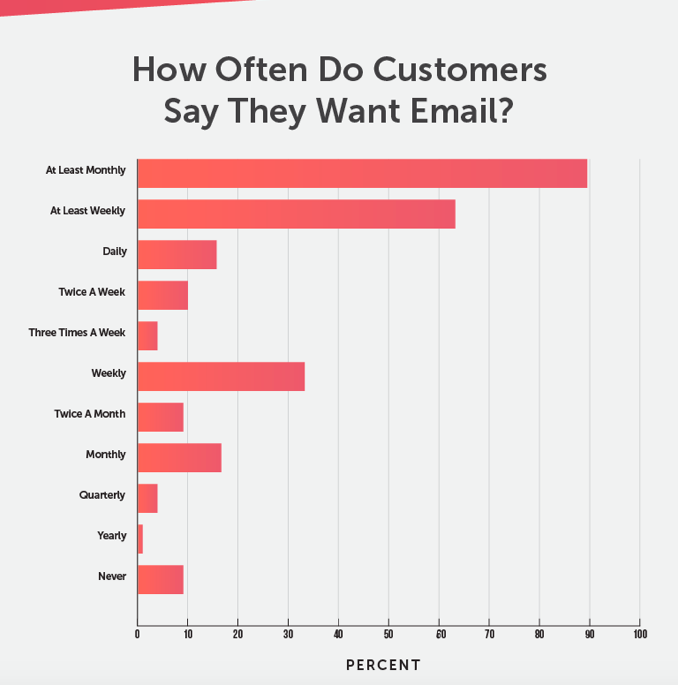
Under-mailing however,  also had a direct impact on sales, and while 48% of people complain about over-emailing,  there is such a thing as a customer preference for more, not fewer emails in specific cases. 

In fact majority of opt-in customers said they wanted at least monthly or weekly emails, according to ClickZ.  Their data shows an insurance company that mailed once a year increased requests for quotes by 48% simply by adding frequency.

B2C emails can be more frequent than B2B

B2C emails tend to be more frequent, say, several times a week, without losing sales and creating unsubs. 67% of B2C companies send email 2-5 times per month. That would loosely fit a bi-weekly or weekly schedule. B2b companies, on the other hand, almost universally said that more than once a week had an adverse impact. 

B2B mailings should be at least monthly, up to 5 times per month

Check clicks, unsubscribes, and sales, to find the “sweet spot”.  Sending in batches of 20 at a time is sufficient for these tests. 

Make sure the content is valuable

Emails that have special offers, seasonal prompts, marketing tips, and new information will drive conversions and keep recipients interested.  

In short, we think the easiest content schedule should be either monthly or weekly. See the next blog (below) for the best time of day and day of the week.

    Let´s do this! Join the PR club HERE. Need a custom quote? Just contact us at hello@techrefs.com, 408.892.9815 or leave a message below


    The best times for SaaS marketers to e-mail a newsletter to media execs

    Recently the VP of a B2B  technology developer asked us when is the best time to send an email newsletter to media executives. 

    The answer is easy, but not simple.

    The ideal time to send B2B e-commerce marketing emails based on open rates (top of funnel educational emails) is 10 a.m on Tuesday (Hubspot, Experian) or Thursday (MailChimp). We pick Tuesday because MailChimp has a lot more B2C data in its data  – literally billions of emails sent.

    But…Wednesday at 10 a.m. is better for clicks and conversions. We found that  Wednesdays emails get 500% more direct response, that is, people scheduling appointments and calling us on the phone.

    So if you are, say, tempting an executive to click to your website to find information to sign-up for a webinar, Wednesday is the better day.

    Another snag is the three hours change in time zones, that is to say, it is always 10 a.m. somewhere.  If your most important market is, say California and you pick 10 a.m. there, the rest of the country – and your prospects – are  going to be in the mid-day email open dead zone.  We would rather send at  10:30 to 11 a.m.  on the East Coast and have more or less most of the country in the prime email opening and clicking hours: Weekday mornings, 8 to 10 a.m.

    Here are some fundamental concepts to know create your email marketing schedule:

    As long as you stay within the 8 a.m. to 10 a.m. window, don´t worry too much about the exact time. 

    But you do want to stay in that zone; almost all studies show that the highest open rates come from sending in morning, around  8 to 10 a.m. Both Hubspot and MailChimp agreeing on a peak time of 10 a.m.

    Opens drop off radically when the send is at noon. If you miss the morning for some reason, there is another bump around 3 p.m.

    Incidentally, Sunday, the worst day of the week to send, is an outlier, time-wise; that day the highest open rate is at 9 p.m.

    About 25% of openers open within the hour.   

    The number of openers quickly reduces as the day continues, so a morning send also allows most recipients to act before the close of the business day. Our own experience  with LocalMediaInsider is that B2B email opens are still going days later in small spurts, but that is probably due to  information being resent to others who are using it for other purposes. 

    Tuesday and Thursday are the best days for open rates, with a (slight) advantage on Tuesday for B2B. 

    For introductions, announcements and general information that do not require a click through, these are better days to send your  email. Think of it this way, is the main point for them to read the email and understand the message, or to click to your website. If its the former, Tuesday is for you. 

    As stated above, Experian  and HubSpot are showing Tuesday is the highest, while Mailchimp, concluded there are more opens on Thursday.  So if you have a B2C option, Thursday may be a better choice.

    Wednesday is still the best day for clicks and e-commerce sales.

    As email marketer Sendblue describes it:

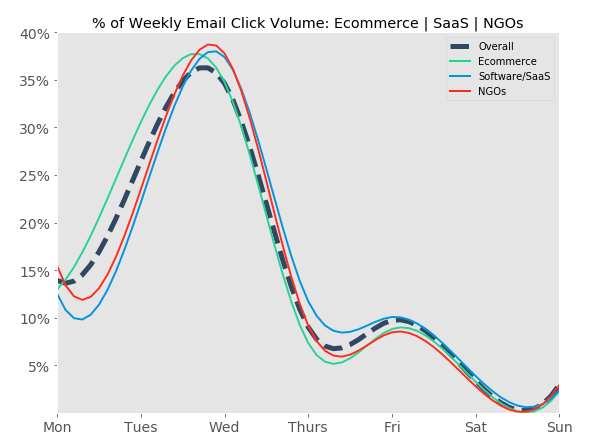
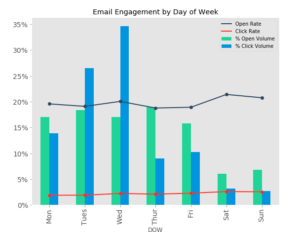
    “Ecommerce, SaaS companies, and NGOs …All three of these industries have spikes for the open volume on Tuesday and Thursday. But, if you look at the click volume graph below, you’ll see that the largest amount of clicks by far takes place on Wednesday.”


    Another email marketer, Sendio, compiled similar data, also shows that B2B e-commerce spiking during the beginning of the week, peaking Wednesday and dropping off (see image at the top of this blog). 

    So if sales is the goal, Wednesday is still the day, followed by Tuesday.

    Other considerations may still trump the Wednesday choice.

    The differences from Tuesday to Thursday are in the 10 to 35% range may be trumped by timeliness that creates extra urgency or relevance.

    For example, reminders should be sent about 24 hours ahead of an important deadline, such as a client contest or webinar,  for maximum urgency.

    As one more email marketer, Jilt, put it, after studying the data,  “While Tuesday and Thursday perform the best, Monday, Wednesday, and Friday aren’t too far behind.

    “If there’s something unique … that makes Monday a better day to send your emails, don’t be afraid to send that day.”

    Otherwise, if you are scheduling a B2B email and want action, Wednesday is the best choice.

      Let´s do this! Join the PR club HERE. Need a custom quote? Just contact us at hello@techrefs.com, 408.892.9815 or leave a message below


      Getting to know premium mobile units, mobile voice search

      Mobile-specific ad units “are experiencing a huge uptick in popularity,” according to Aimee Eickley, of Times Shamrock digital media group.  Created on Impact Engine´s platform,  popular units include mobile slider and mobile video ads.

      “While 40 to 50 percent of our web traffic at the Republican-Herald comes from desktops, the perception of many of our local advertisers is that people exclusively visit the Herald using mobile phones,” she explained, to the Media Tech Reporter this week.

      In other news, the reporter noted that local media are beginning to understand how their companies are impacted by voice search.  Monosolutions has just released a new white paper explaining the basics.  The company builds turnkey websites for small businesses and already pre-structures data, such as FAQ´s, for voice search. They contend that basic websites which can be built from templates in a couple of hours are necessary to any agency’s full stack.   Download the white paper  here. 


      newhomesguide.com

      WeHaa signs The Washington Post, builds NewHomesGuide.com

      The Washington Post has selected WeeHaa, a leading developer of promotional platforms for automotive and real estate industries, to relaunch its NewHomesGuide.com.  Previously, the newspaper company had had numerous issues with ease of use of the site, which aggregates 1200 new home builders and 4000 new home communities in the Washington, D.C. area.

      The new platform, built in two months, solved these issues allowing a seamless hands-off experience for both advertisers and for the newspaper staff.   The new platform will allow the Washington Post to take advantage of a lucrative niche in the red-hot D.C. area real estate market.

      WeeHaa is best known for creating turnkey automotive virtual sales and expos that media can use to upsell. car dealers, or reengage with the category. They also create a turnkey real estate agent marketing platform on Facebook. Both utilize real-time automated inventory updates. Clients include Seattle Times and BH Media.

      ginny

      I dream of Ginny: Secrets of a 60% CTR from one email

      Recently LocalMediaInsider, our parent company,  sent an email that had a spectacular 60% click-through rate from time-crunched, over-informationed local media executives.

      What to know how we did it?

      First off, we wrote a case study on a Facebook messenger bot named Ginny, developed by the Virginia Pilot newspaper. It  was a rare example of an traditional media company developing its own innovative technology, plus it is monetizable and fun, with a charismatic project leader, who spoke at a Local Media Association event.

      So we expected a great click through rate.

      But here’s our dirty little secret: It was our second try.

      Here is how we saved Ginny and turned her into a super star:

      1. Starting with a great list

      We always start B2B marketing campaigns with a super-targeted opeed-in email list of business-side executives, in this case media executives interested in transformative change; that’s pretty much most of them today.

      A best practice of LocalMediaInsider is also to continually cull the list  to eliminate anyone who has not clicked in six months and  to build even more targeted ‘interest groups’, ie media executives that read topics that span from audience data and self-serve advertising sales to digital agency services.   These segmented lists get as much as 78% open rates and are a gold mine for our sponsors.

      However, in this  case we sent Ginny´s case study to the entire list, so the audience alone was not responsible for the big results.

      2. Choosing a subject line that poses a ¨need to know” question

      The subject line not only affects the open rates, but also  click through rates. When we send an email with multiple articles, we will sometimes send two emails one with the first key topic, and make that also the lead story, and then a second one to non-openers with a new topic, and change the lead story to match.

      Those who are interested enough to open, are also more likely to click, so the click rate will show as a higher percentage.

      In this case  the first  subject line, “MediaTechReporter: Ginny the FB messenger bot debuts…”  had a big open rate, but just 21 unique clicks overall.  Clearly, the subject line was not the problem.

      Still we enhanced the subject line  a bit and went with:  Should your media company use a social media bot?   This subject line delivered 75% of the number of opens as the first subject line,  from an audience of previous non-openers. A winner!

          3.  Going exclusive 

      In email marketing, it is easy to burn out a B2B audience by sending too many exclusive emails. However, exclusive emails have more click throughs, so there is always a tension between “Do I put this in a newsletter” and “Do I send an exclusive email, with only this information?”

      At LocalMediaInsider,  the Media Tech Reporter  is designed as a “quick read” once a month for busy execs. Some of the information is news in itself, ie not intended to be clicked.  But even with five or six news items, a promotional blurb that “sells” content on the other side of the click can deliver 400 click throughs.

      On our first send, however, out of five or six other topics in the Media Tech Reporter,  the Ginny story got about half the clicks.

      The new subject line, Should your media company use a social media bot?  was also sent as the exclusive content in the email,  and had  but 50 times more click throughs. 

      Maybe the subject line was better at targeting the right people, or the  copy in the email was better, but exclusivity certainly also helped.

            4. The copy: Telling  a better story

      Now let’s take a look at the copy in these two emails to see how writing itself made a difference.

      The test in the first  email was a typical news item delivered in a conversational voice (email text in italics here):

      Ginny, the Facebook messenger bot debuts at the Pilot

      In case you missed the 2018 Digital Revenue Summit, one media company finally got in the game of bot development and created Ginny, a Facebook messenger bot, who delivers news tips and takes customer complaints. Check out  how they did it here, and be prepared to be charmed. 

      Granted it had to compete with five other topics in the newsletter, but could that account for a 600% increase in click throughs? Probably not.

      A key difference is the  second email told a  better story. Here is the headline and text for the second email:

      Exclusive: Should you use a FB messenger bot?

      It is always encouraging to see media developing new tools, and one of the more clever innovations we’ve seen this year is Ginny, a Facebook messenger bot developed by the Virginia Pilot. 

      Why you ask? And do you need one? Ginny is primarily used to instantly route common customer service complaints and sign-up readers to sports and weather text alerts, hands free. How do you get one? In this blog, the Pilot explains how they built Ginny. If you are not up for that, we’ve included a contact at the Pilot, which plans to offer the technology to other media companies. 

      Spoiler alert: When I log on to test it out, Ginny is charming and  reminds me, “Remember, I´m a (emoji image of a bot) so I may occasionally need a little help and some patience.”

      So I lie.  

      I tell her that my newspaper was wet this morning.

      Read more. 

      Yep, that got their attention.

      In the engagement hierarchy, advertising is at the bottom,  any kind of newsworthy content is one step up, but great story-telling is at the top.

      5.  Changing font size and copy length 

      A last lesson is that we also increased the  font-size, and shortened the length of the second email.

      The first MediaTechReporter was in 12pt type and  an down the length of two screens.   We placed new Ginny the Bot email promotion  in 14 pt type.

      Here is an explanation on font size for marketing email from DirectIQ: 

      Most marketers and design professionals now agree that the minimum font size for body text in emails and blog posts is now 12-point. Many suggest 14-point or even 18-point font because the screens of desktop monitors tend to be farther from people’s faces than printed media they hold in their hands. Also, people do not experience text on a mobile device the same way they do on a sheet of paper.

      Larger font sizes are more comfortable for people to read. This comfort correlates to positive emotions that make readers more willing to continue reading and to convert.

      We also made sure the email was more  “friendly” in length; it  took up just a few inches, making it simple to read without scrolling.  The word count came in at  just under 200 words.

      Hubspot, based on the results from 40 million B2B emails, says that’s a good length:

      Data suggests the ideal length of an email is between 50 and 125 words. Emails this length had a response rate above 50%. A similar study found emails with approximately 20 lines of text, or about 200 words, had the highest clickthrough rates. When in doubt, keep emails short and under 200 words.

       We felt we could get the critical information into a few paragraphs and it worked!

      6. Time and day of send 

      Yeah, it counts a lot, both on LinkedIn and on direct email.  We moved the post to what we have found is our best time and day for conversions, in this case, click throughs.

      End result

      Of 1000 media executives who opened this email, 600  clicked through  to read the story. If the Virginia Pilot was marketing this product that would be an excellent list for them. Tested content like this is great for LinkedIn ads to develop even more prospects.

      If you like the way we think, let us put content marketing to work for your company.
        Let´s do this! Join the PR club HERE. Need a custom quote? Just contact us at hello@techrefs.com, 408.892.9815 or leave a message below


        Site Impact partners with sales trainer

        Site Impact, has partnered with Diane Hayes Sales Training & Consulting  to provide high-impact in-person training services for email-marketing clients nationwide.

        “Site Impact is a cutting-edge company in the Email Marketing space,” said Diane Hayes, CEO of Diane Have Sales Training.

         “I am honored to be chosen as one of their sales training service providers. Site Impact´s forward thinking technology and customer-facing dashboards are incredible, and their customer service is tremendous. Together we make a great team for growing revenue.”

        “Diane Hayes Sales Training & Consulting connects the dots between sales training and revenue generation,” said Brandon Rosen, CEO of Site Impact.

         “Her in-depth knowledge for training and selling translates into confidence in our products, as well as additional revenue and increased sales success.”


        Media Tech Reporter launches

        We’ve gone and done it.

        Media Tech Reporter, an email newsletter covering technology for journalism based media, starts up this summer.

        The Reporter is a project of  LocalMediaInsider, which covers business case studies for local media companies, and TechRefs, its marketing partner.

        It is intended to be a quick hit of news about revenue opportunities from new platforms, and news about their partnerships, integrations and upgrades.

        “It is still  time-consuming and expensive for media to keep up-to-date on what new technology is available, easy to implement, and has an ROI,” said Alisa Cromer, publisher of LocalMediaInsider.

        To create the newsletter, Media Tech Reporter´s journalists cover technology demonstrated at conferences and online, and talk to analysts and media about how they view these opportunities, and provide memberships for R&D partners to deliver their information.

        The newsletter will cover:

        • New platforms and technology demoed at trade conferences
        • New products and features
        • New clients added
        • New Case Studies and White Papers released
        • New integrations and partnerships
        • Key hires and milestones
        • Statistics from research that show trends

        To guarantee inclusion in the newsletter, technology companies can subscribe  to the service that includes one post per month, reaching the opted-in email database of 25,000.

        “We also have a content team that writes and advises on messaging, so this is really a full service subscription,”  Cromer said.

        For more information on how to send in a release or subscribe, contact alisa@techrefs.com.


        How to find prospects from your LinkedIn posting

        Most LinkedIn users know enough to check-out who has viewed their LinkedIn profile and can roughly correspond a bit of this traffic to posts they have sent out.

        But there is another way to see who has viewed a post.

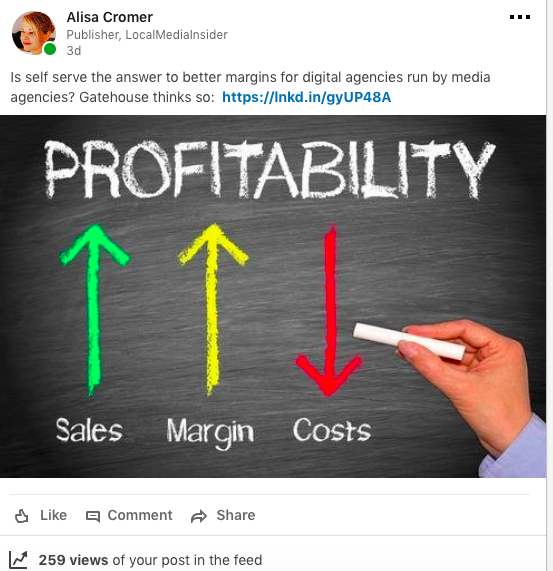
        One of TechRefs services is to repost high value content we create for clients. Take this repost of a content marketing story published  on LocalMediaInsider. 

        The native article shows how self-serve marketing platforms developed by iPublish Media use design automation and back end integrations to enable local media companies to produce high margins on sales to small businesses.

        The tools open up a previously unaddressed market:  Millions of SMB´s (translate to 10,000 plus prospects in most mid-sized markets) that  traditional media companies ignored for decades, due to the mismatch between what small businesses can pay for marketing and what media must spend to support the buy.

        This is valuable information!

        To post on LinkedIn, we first upgraded  the image to the one above this article.

        Then, we posted it from a company executive, rather than the company page, as the executive has the larger personal following.

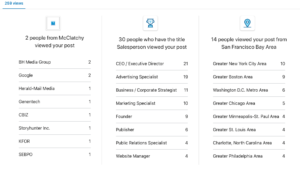
        The post got a a nice boost of traffic,  259 views.  The first thing we look for is who has liked and shared the post. In this case, we just got reads. connection.

        To see who else read it,  we clicked on the  ¨259″ under the post.

        That surfaced the view below, which we have intentionally made  smaller to to disguise the actual companies,.

        However, we found the names of companies who clicked the most  are in the left hand column, job titles are in the middle column, and where they are located is  in the left column.

        Now, it is also possible to look back to the “whose viewed your profile” area and match viewers to any of these companies  in about 24 hours after to post, and find the name of executives likely to be interested.

        To begin a dialogue with people who are interacting with your posts, invite them to connect, and ask about  their interest is in the subject matter. Messages can be created in advance, depending on how aggressively or strategically your company moves prospects through the sales funnel.

        Many thanks to super LinkedIn marketer and client Kim Johnson, VP of Sales at iPublishMedia for pointing out this functionality in LinkedIn.

        Happy hunting!

        How large an email audience of business-side local media execs can you reach?

        In the local media space,  there are a variety of email newsletter, in addition to companies like PRNewswire. Each audience is slightly different.

        The company with the largest business-side email audience  in 2018 is arguably LocalMediaInsider. Their reach of 31,000  includes conference attendees, LinkedIn group members, and proprietary data collected on TV, radio, newspaper and magazine audiences.

        “PRNewsWire´s revenue side job titles are just  a subset,” she said.

        Seven years in the making,  it is the largest opt-in email list of targeted  revenue-side media executives in English speaking markets worldwide, we’ve been able to find.

        “We are now segmenting the list into a variety of interests such as self serve, email, or circulation data based on the audience path.  Each of these segments have an open rate of 78%,” said Alisa Cromer, publisher.

        Here is the overall break down:

        • Media Press 242
        • Radio 4,781
        • Television 4,048
        • Magazine 6,000
        • Association 297
        • Technology companies 1,119
        • Out-of-office contacts added to opt-in to give depth within companies
        • Newspapers 14,135

        .What this means for SAAS companies who sell to or through  local media as resellers is they can reaching deeply across media channels with one buy.

        LocalMediaInsider also specializes in content marketing programs – case studies, awards sponsorships and  best practices –  to convey more complex educational messages.

        “If you are selling something everyone already understands, such as an email platform,” a small online display ad will work,” Cromer said. “But often the task is more educational.”

        LocalMediaInsider also gives clients a curated list of leads who are “most likely to be interested” and already familiar with the advertiser brand and value proposition, based on personal knowledge and data behaviors.

        “For SAAS companies who partner with the media industry, content marketing to this core group is the most powerful and efficient  way to reach prospects ,” she said.

        “Conferences cannot be neglected, but this makes them more effective and amplifies reach.”

        Native marketing campaigns are designed to match LocalMediainsider´s voice and feel. TechRefs is the marketing division that creates and distributions native marketing to LocalMediaInsider´s audience.

        Cromer believes LocalMediaInsider´s email audience is not the largest  revenue side list available of English-speaking media executives.

        “We don’t want to mistake these numbers, so  you know someone with a larger opt-in audience, please let us know.”

        E&P´s list of media executives comes close, but is split between editorial side and revenue side executives.


        Best of Local Media and TOP ADS 2018 are looking for SAAS partners

        Client cases studies  are so powerful that SAAS companies should have one for  each vertical and/or product.  But they are also often hard to obtain. Few digital agencies or media companies want to promote their white label partners. In fact, they typically don’t want their end users to know about the partnerships at all.

        So how do they speak to the industry, but not the end user?

        One powerful way to acquire case studies and street credibility is to partner with LocalMediaInsider´s  awards programs.

        Media clients  enjoy the prestige of the nomination and possible win;  the case study is written by professional journalists at the credible trade press, and the award itself can be used to brand the media company as not only digital savvy, but also a national winner in their area.

        Trade association also have contests, but these are often insular at worst, or cliquey at best, since winners are only chosen from members.

        Best of Local Media Awards, on the other hand, is inclusive and has no entry fee, helping make the awards central to the industry overall.

        They rely on a board of industry experts and relationships with SAAS platforms nominating their most successful clients, to create a more definitive result.

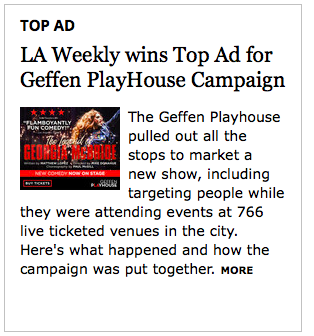
        Another popular program LocalMediaInsider  produces Top ADs, designed to reward local media for creating great campaigns for local businesses. Every nominee is written up, promoted and categorized in LocalMediaInsider´s industry category list, an archived list of successful ideas for local reps to tap into when calling on small business clients.

        Again,  white label platforms can recognize their resellers by sponsoring a  category  (Top Ads programmatic, Top Ads Automotive), and nominating  end user campaigns they already know are most successful,  via their own analytics.

        The media resellers, of course, have to agree, but it is a win/win for everyone. Reseller agency and media, and their  sales reps and  customers,  can add award decals to professional credentials and  websites. The SAAS company achieves branding and links to case studies from a credible media source.

        Here’s how it works:

        • The SAAS sponsor nominates several outstanding campaigns created by an agency or media company using their platform.
        • A journalist contacts the nominees and writes them up. These case studies are published weekly in LocalMediaInsider and distributed by email.
        • At the end of the year, all the Top Ad winners are announced and invited to attend a virtual Awards banquet.
        • The sponsors logo and value proposition are mentioned in all the emails, and they cohost the banquet. The cost is per nominee.

        For more information on sponsoring either Best of Local Media or Top ADs in 2018, please contact alisa@techrefs.com